
So, you’re ready to launch your online store — or maybe you’re thinking about switching platforms. Either way, there’s a question you’ve probably Googled at least twice already: Should I go with WooCommerce vs Shopify?
Honestly? It’s one of the most common decisions online business owners in the US, UK, and Canada wrestle with. And it’s not a simple answer. Both platforms are genuinely powerful, both have loyal communities, and both can absolutely work for your business — depending on what your business actually needs.
In this guide, we’re going to skip the generic pros-and-cons tables you’ve already seen a hundred times and actually break this down the way a consultant would: based on your goals, your budget, your technical comfort, and where you want to be in two years.
Let’s get into it.
First, Let’s Set the Scene
Before we dive in, it helps to understand what each platform actually is — not just technically, but philosophically.
Shopify is a hosted, all-in-one eCommerce solution. You pay a monthly fee and Shopify handles hosting, security, updates, and a lot of the technical heavy lifting. It was built specifically for selling online, and it shows. Everything about Shopify is designed to get products in front of customers as fast as possible.
WooCommerce, on the other hand, is a free, open-source plugin that sits on top of WordPress. It’s not a standalone platform — it’s more like giving WordPress the ability to sell things. That distinction matters a lot, because it means WooCommerce inherits everything WordPress is (flexible, powerful, slightly complex) and adds eCommerce on top.
Think of it this way: Shopify is like moving into a fully furnished apartment. WooCommerce is like buying a plot of land and building your house exactly the way you want it.
Neither is better in an absolute sense. But one of them is almost certainly better for you.
Ease of Use: Who Wins for Beginners?
Let’s be real — if you’re not a developer, your first question is probably “which one is easier to use?”
Shopify wins this one, and it’s not particularly close.
You sign up, pick a theme, add your products, connect a payment method, and you’re live. The interface is clean, the onboarding is guided, and support is available 24/7. For someone who just wants to sell and doesn’t want to think about the technical side, Shopify is genuinely impressive.
WooCommerce has a steeper learning curve. You’ll need to set up WordPress hosting first, install WordPress, install WooCommerce, configure your settings, and then start customising. If something breaks (and sometimes things do), you’re usually Googling your way through it or hiring someone to fix it.
That said — once you get past that initial setup, WooCommerce isn’t actually that hard to manage day to day. Most store owners find a rhythm with it pretty quickly. The challenge is the beginning.
Verdict: Shopify for beginners. WooCommerce for people who are comfortable with WordPress or have a developer on hand.
Pricing: What Are You Actually Going to Pay?
This is where things get interesting — and where a lot of comparisons get it wrong.
Shopify pricing (as of 2026):
- Basic: $39/month (USD)
- Shopify: $105/month
- Advanced: $399/month
- Plus there’s a transaction fee on each sale (0.5%–2%) unless you use Shopify Payments
Those transaction fees add up fast. If you’re doing $20,000 a month in revenue and not using Shopify Payments (which isn’t available everywhere in the UK and Canada at the same level as the US), you could be handing over $400+ a month just in fees.
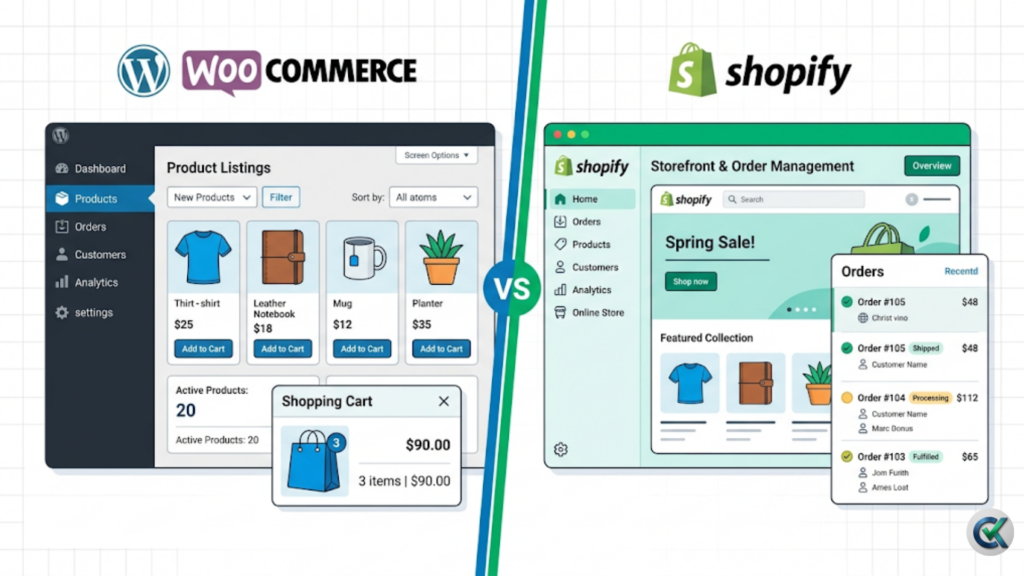
WooCommerce pricing:
- The plugin itself: Free
- Hosting: $5–$30/month for most small stores (more for high traffic)
- Domain: ~$12–$15/year
- Premium themes: $30–$100 one-time
- Extensions: varies — some free, some $50–$300/year
On paper, WooCommerce can be significantly cheaper — especially for stores that are growing fast and want to avoid percentage-based transaction fees entirely. But the “hidden costs” — developer time, security plugins, premium extensions — can close that gap depending on how complex your store gets.
Verdict: WooCommerce is generally more cost-effective at scale. Shopify is more predictable upfront. For US, UK, and Canadian sellers doing under $5K/month in revenue, the price difference is minimal. Over $20K/month, WooCommerce often wins on cost.
Design & Customisation: How Much Control Do You Want?
Shopify has a solid theme marketplace with both free and premium themes. They look professional, load fast, and work well on mobile. You can customise colours, fonts, layouts — a lot, actually — without touching code. If you want to go deeper, Shopify uses its own templating language called Liquid, which is learnable but not standard.
WooCommerce, because it runs on WordPress, gives you access to the entire WordPress theme ecosystem — which is massive. Combine that with page builders like Elementor or Kadence, and you can build virtually anything. There are no design restrictions. If you can dream it, you (or your developer) can build it.
For businesses that need a unique brand experience — something that doesn’t look like every other Shopify store — WooCommerce is the better playground.
Verdict: WooCommerce for full creative control. Shopify for polished, fast results without needing a designer.
SEO: Which Platform Helps You Rank Better?
Both platforms can rank well in Google. Let’s be honest about that first.
But there are some differences worth knowing.
Shopify’s SEO fundamentals are solid — clean URLs, auto-generated sitemaps, fast loading speeds, mobile optimisation. However, it does have some quirks: duplicate URL structures for product pages and some limitations on how you can structure your site technically. For most businesses, these won’t be dealbreakers, but for SEO-heavy content strategies, they can become friction points.
WooCommerce, because it lives on WordPress, works seamlessly with tools like Yoast SEO or Rank Math — widely considered the gold standard for on-page SEO control. You get full control over meta tags, schema markup, canonical URLs, content structure, and blog integration (which matters a lot for content marketing). WordPress was literally built as a content management system first, so the SEO capabilities run deep.
If content marketing and organic search are a big part of your strategy — especially for competitive markets in the US and UK — WooCommerce tends to give you more technical SEO horsepower.
Verdict: WooCommerce has a slight edge for SEO, especially for content-driven stores. Shopify is perfectly capable and sufficient for most stores.
Payment Gateways & Currencies (Important for US, UK & Canada)
Both platforms support major payment processors — Stripe, PayPal, Square, and many others.
Shopify Payments is available in the US, UK, Canada, and Australia, which removes transaction fees if you’re in those markets. That’s a genuine advantage for North American and British sellers.
WooCommerce integrates with virtually every payment gateway on earth, and since you’re not paying platform transaction fees regardless of which gateway you use, your flexibility is higher. This matters particularly if you’re selling across borders — US to UK, Canadian stores selling to the EU — because WooCommerce lets you configure multi-currency setups with more granularity.
Verdict: Tie for US/UK/Canada specifically. Shopify Payments is convenient. WooCommerce wins globally.
Scalability: Which Platform Grows With You?
If you’re planning to build a serious, large-scale operation — thousands of SKUs, complex inventory, B2B + B2C, subscription products, custom checkout flows — this is an important question.
Shopify scales well and has Shopify Plus for enterprise-level stores. The tradeoff is cost (Shopify Plus starts at $2,300/month) and the fact that you’re always working within Shopify’s ecosystem. Some advanced customisations are simply not possible without workarounds.
WooCommerce scales well too, but the responsibility is on you (or your developer) to make sure your hosting infrastructure keeps up. Managed WordPress hosts like WP Engine or Kinsta make this much easier, but it’s still something you need to actively manage.
For most small to medium businesses in the US, UK, and Canada, both platforms scale just fine. Where WooCommerce really shines at scale is flexibility — you can extend it in ways Shopify simply doesn’t allow.
Verdict: Shopify for hands-off scalability. WooCommerce for custom, complex stores.
Customer Support: What Happens When Things Go Wrong?
Shopify wins here, clearly. 24/7 live chat and email support, a massive help centre, and an active community. When something breaks at 11pm before a big product launch, Shopify support is there.
WooCommerce is free and open-source, so there’s no dedicated support team. You rely on community forums, your hosting provider’s support, and the plugin’s documentation. Premium plugins usually come with their own support channels, but it’s more fragmented.
If you’re running your store solo and aren’t technically inclined, this matters more than you might think.
Verdict: Shopify, without question.
So, Which One Should You Actually Choose?
Here’s the honest answer most blog posts avoid giving:
Choose Shopify if:
- You’re just starting out and want to launch quickly
- You don’t want to deal with the technical side of running a website
- You value 24/7 support and predictable costs
- You’re in the US, UK, or Canada and will use Shopify Payments
- You’re running a straightforward product store
Choose WooCommerce if:
- You already use WordPress or are comfortable with it
- You want full control over your store’s design and functionality
- SEO and content marketing are central to your strategy
- You want to avoid long-term transaction fees
- You have access to a developer (even part-time)
- You’re building something complex or highly customised
A Quick Word for Canadian and UK Sellers
One thing worth noting — pricing on Shopify is in USD, which means Canadian and UK sellers are paying in a foreign currency. With exchange rates fluctuating, your Shopify bill in CAD or GBP can vary month to month. WooCommerce’s costs (mostly hosting) are often billed locally, which gives you more cost stability.
Also, if you’re in Canada or the UK and your preferred payment processor isn’t Shopify Payments, the transaction fees bite harder. Keep that in mind.
Final Thoughts
Both WooCommerce and Shopify are excellent platforms. Neither is inherently “better” — the right answer depends entirely on your situation.
What we will say is this: don’t just pick the one that sounds easier or cheaper on day one. Think about where you want your store to be in 18 months. Think about whether you value flexibility or simplicity more. Think about your team’s technical capability.
If you’re still not sure which platform is the right fit for your business, we’d love to help. At KavcomExpert.com, we work with eCommerce businesses across the US, UK, and Canada to build, optimise, and scale their online stores — on whatever platform makes the most sense for them.
Reach out to us, and let’s figure it out together.
Was this helpful? Share it with someone who’s trying to choose their eCommerce platform — you might save them a few hours of research.