
Last quarter, one of our clients shipped a 40-second product video that pulled real, tracked revenue into the business. Nobody held a camera. No studio, no lighting kit, no shoot day blocked off on a calendar. The whole thing was scripted, generated, and cut in an afternoon, and watching the final edit you’d have no idea.
That’s the shift worth paying attention to. The video editing trends shaping social media in 2026 aren’t a new transition everyone copies for a month or a color preset that floods your feed and then dies. They’re a rewrite of how video gets made, who makes it, and what “good” even means inside a feed that scrolls faster every year.
We edit a lot of video at Kavcom Expert. Real estate brands, CPA and accounting firms, founders trying to build a face for their business. So these five aren’t trends we read about in a roundup somewhere. They’re the ones quietly rewiring our own production process right now.
What are the biggest video editing trends for 2026?
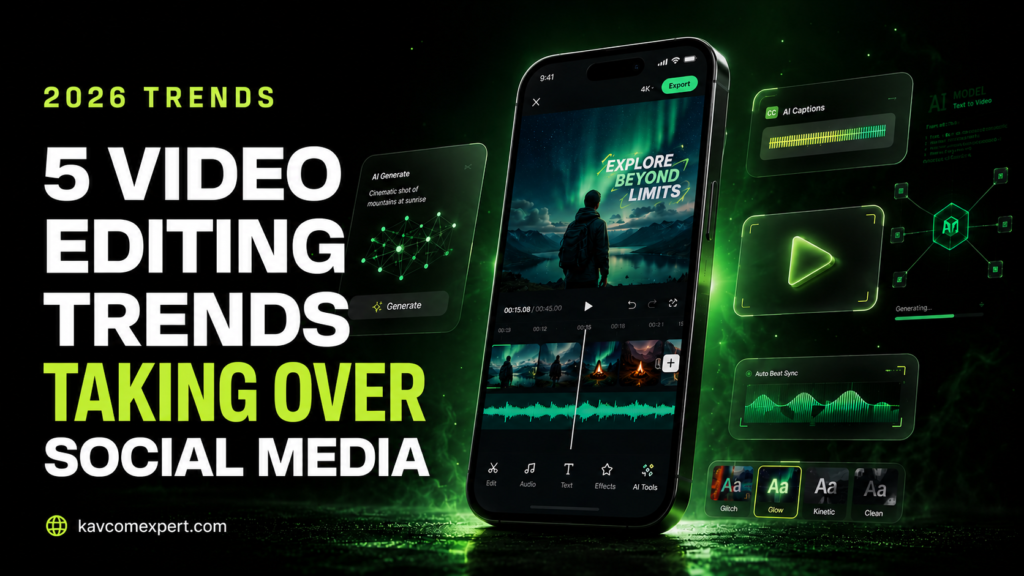
The biggest video editing trends for 2026 are AI-native editing with multi-model generation, faceless content powered by lifelike AI avatars, retention-first platform-native editing, a swing back toward raw and authentic footage, and sound-first design built for muted, caption-led viewing. Together they reward three things: speed, realness, and edits engineered for the first 1.5 seconds of attention.
Now let’s get into each one and, more usefully, what to actually do about it.
1. AI-Native Editing Is the New Baseline, Not the Gimmick
A year ago, “AI in video editing” mostly meant an auto-caption button and a filler-word remover. Handy, but a feature. In 2026 it’s the layer the entire edit sits on top of.
Here’s what changed under the hood: serious editors stopped looking for one magic tool and started routing different shots to different engines. Need a cinematic 4K establishing shot with native audio baked in? That goes to Google Veo 3.1. Need tight camera control and a character who looks consistent across cuts? Runway Gen-4.5. Need realistic humans at volume without burning your budget? Kling has been generating clips for around seven cents a second, which makes high-output social work actually affordable.
The quiet winner in all this is CapCut. It went and dropped Sora 2 and Veo 3.1 straight into its editing timeline, with no watermark on exports. So a social media manager on zero budget can prompt b-roll, generate a talking scene, and finish the cut in one window. That used to take three tools and a paid subscription.
But here’s the part the breathless AI threads get wrong. Most of these models still generate clips in three-to-ten-second chunks. You don’t type one prompt and receive a finished film. The real skill is storyboarding each shot, generating several versions, picking the best, and stitching it all together in a proper editor. The editor’s job didn’t disappear. It moved up the chain, from cutting clips to directing them.
One more thing worth saying out loud: OpenAI is winding down the Sora app and API this year. Tools that look untouchable today can be gone in six months. So build the muscle, not loyalty to any single model. The agencies that win treat their stack like a toolbox, swapping engines per project, usually running two or three at once.
2. Faceless Content and AI Avatars Stop Looking Fake
For years, “faceless content” was a side-hustle thing. A bit cheap, a bit obvious. In 2026 it’s a legitimate business model, and a lot of channels have replaced the entire on-camera workflow with AI generation. No presenter, no shoot, no problem.
What flipped it was the avatars finally crossing the uncanny valley. HeyGen’s Avatar IV and tools like it now produce lip-sync so tight that, in plenty of side-by-side tests, people genuinely can’t tell. You type a script, pick a presenter, and a finished talking-head video lands in a couple of minutes. We’ve built a branded AI presenter for our own channels, so this isn’t theory for us. It works, and it scales in a way a human shoot never will.
The use cases that matter for a business: one consistent brand spokesperson who never has a bad hair day, multilingual versions through AI dubbing and voice cloning so you reach new markets without reshooting a thing, and a way to put a “face” on content for the service businesses that quietly hate being on camera. Accountants and financial advisors, I’m looking at you.
The catch, and it’s a real one: avatars are brilliant for volume and consistency, and terrible for trust if you lean on them for everything. People can feel when there’s nobody home. The smart play is a hybrid. Put your actual founder on the content that builds the relationship, and let the avatar handle the explainer volume in between.
3. Retention-First, Platform-Native Editing Wins the Feed
Every social algorithm pays you in watch time. So editing in 2026 is basically reverse-engineered from the retention graph.
That starts with the hook. The first second, maybe a second and a half, decides whether anyone sees the rest. No slow intros. No logo sting. No “hey guys, welcome back.” If your edit takes four seconds to get to the point, the point doesn’t matter, because they’re gone.
Vertical is no longer a post-production crop, either. You frame for 9:16 on the shoot, with the subject centered and the composition built for a phone held in one hand. Then it’s fast, modular cuts, a pattern interrupt every few seconds, b-roll layered in to hide the joins and keep the eye moving.
The bigger change is that the “make one video, post it on ten platforms” promise is mostly dead. A TikTok cut, a Reels cut, and a LinkedIn cut are different animals. Different pacing, different caption style, different length, sometimes a completely different hook for the same footage. Teams that still export one master and dump it everywhere are leaving most of their reach on the table. The ones who win re-edit per platform, even when it’s the same source clips.
And don’t sleep on mid-form making a comeback. Longer Shorts and video podcasts are pulling editors back toward clipping long conversations into native short pieces. Record once, carve out ten.
4. The Authenticity Swing: Why Lo-Fi Beats Over-Polished
Here’s the counter-trend, and it’s the most interesting one. As AI floods every feed, audiences are getting AI-fatigued. The thing that now cuts through the noise is content that feels unmistakably human.
A bit of camera shake. Walking with the subject. Imperfect framing. Talking straight to camera with no script polish, in one take. “Filmed on a phone in my car” is outperforming the glossy studio piece in a lot of niches, because it reads as a real person rather than a brand performing at you.
You can see it in the color, too. The heavy stylized grades are fading out in favor of natural skin tones, muted cinematic looks, and grading that feels true to life rather than Instagram-filtered. Realness, even in the color pass.
The irony is almost funny. The same teams generating AI b-roll in trend number one are deliberately editing their human moments to look unedited. Polish has quietly become a signal that says “this is an ad, skip it,” while rough says “this is real, watch it.” So leave the jump cut that’s obviously a jump cut. Keep the slightly awkward open. Authenticity in 2026 is a deliberate editing choice, not laziness, and there’s a real difference between the two.
5. Sound-First, Caption-Default, Motion-Heavy Editing
Most social video gets watched on mute, mid-scroll, with a thumb hovering. So the edit has to land with the sound completely off. If your video only makes sense with audio, you’ve already lost most of the audience.
Captions are the default now, not an accessibility afterthought. The best ones are kinetic, animated to pace with the speech, burned in, styled, and on-brand rather than the bland auto-generated white box. Add kinetic typography, clean UI-style overlays, progress bars, and minimal animated icons to steer the eye exactly where you want it and hold attention through the cut.
That said, sound design has become the actual differentiator for the people who do unmute. Algorithms reward richer engagement, and crisp audio lifts watch time in a measurable way: sound effects that punctuate the cuts, music with its beats matched to the edit, a clean voiceover with no muddy room tone. Motion graphics and sound design used to be advanced extras. In 2026 they’re baseline skills for anyone editing seriously.
The target is a video that’s fully legible on mute and genuinely rewarding with the sound on. Hit both and you’ve covered how everyone actually watches.
How to Actually Use These Video Editing Trends in 2026
Don’t try to chase all five at once. That’s how teams burn out and ship nothing. Pick your lane and stack them deliberately.
For most brands the playbook looks like this. Build an AI-assisted production pipeline so you can ship real volume without a shoot every week. Keep a human or founder anchor for the content that has to build trust. Re-edit per platform instead of spraying one master everywhere. Caption everything, no exceptions. And let your “human” content stay a little rough on purpose, because that roughness is doing a job.
The teams pulling ahead in 2026 aren’t the ones with the best cameras or the biggest editing suite. They’re the ones producing more, faster, in a voice that feels real, treating editing as a strategy rather than the last box to tick before publishing.
Video stopped being the thing you make after the strategy. This year, it is the strategy. Every one of these video editing trends points the same direction: faster production, a realer feel, and edits built for how people genuinely watch.
If your brand is still treating video like a once-a-month studio event, that gap is going to start showing in the numbers. At Kavcom Expert, video editing is one of the things we do every single day, for real estate, finance, and founders who’d rather build the business than learn Premiere. If you want your feed to keep pace with 2026, that’s a conversation worth having.