 Kavcom Expert
Zero-Click Search and AI Overviews: What the 2026 Data Actually Says (And What to Do About It)

Quick answer
Zero-click search has moved past the halfway mark of all Google queries, and a page sitting in position one can lose 40 to 60% of its expected clicks the moment an AI Overview shows up above it. That doesn't mean SEO is dead. It means there's a second goal now sitting next to "rank #1": getting your content cited inside the AI-generated answer itself. That takes direct-answer formatting near the top of the page, real statistics and named sources in your content, cleaner structured data, and watching Google Search Console for the specific pattern of impressions holding steady while clicks fall.
Key takeaways
- Zero-click search has climbed from roughly half of all Google queries a few years back to a clear majority in 2026, and every tracking study shows it still rising.
- When an AI Overview appears above the #1 organic result, click-through rate for that page typically drops 40 to 60%, depending on which study you look at.
- The damage isn't even. "What/how/why" informational content gets hit hardest. Local, transactional, and highly specific queries hold up much better.
- Google's own line is that optimizing for its AI search features "is still SEO." That's true, but the tactics that actually win citations go further than a standard SEO checklist.
Zero-click search happens when a searcher gets a complete answer directly on the results page, usually from an AI Overview, and never clicks through to a website. It now affects most Google searches, and it hits informational content the hardest. The way to respond isn't to abandon SEO, it's to add generative engine optimization (GEO) on top of it: writing content that's structured and sourced well enough that AI systems choose to quote it, even when the user never sees your homepage.
What "Zero-Click Search" Actually Means
Type a question into Google right now. There's a decent chance you get your answer before you ever see a blue link.
That's zero-click search. It's what happens when a searcher's question gets answered directly on the results page, through a featured snippet, a knowledge panel, or increasingly an AI Overview, and they never open a website at all. It's not a new phenomenon. Featured snippets have been doing a version of this for years. What changed is the scale. AI Overviews don't just answer one narrow question type, they synthesize an answer from multiple sources for almost any informational query, which means a much bigger slice of search traffic now resolves without a click.
If you run a WordPress site, a WooCommerce store, or a services business that leans on blog content for organic leads, this is the shift sitting underneath every "why did my traffic drop even though rankings look fine" conversation happening in marketing right now.
The Numbers, Without the Spin
Here's what the current research actually shows, not the recycled "SEO is dead" version that gets passed around LinkedIn.
A randomized field study covered by Search Engine Journal found that removing AI Overviews from the top of the results page nearly doubled outbound clicks for the queries where they'd normally appear. The same coverage cites Pew Research data showing people click through when an AI Overview is present about 8% of the time, versus 15% of the time when it isn't, and references Ahrefs' analysis of Search Console data putting the click-through rate drop for top-ranking pages at 58% once an AI Overview shows up above them.
Separately, First Page Sage's 2026 AI traffic impact report tracked zero-click search over time and found it's now at 74.6% of tracked searches, up from 54.1% in 2022. Their panel data also found AI Overviews cutting organic clicks by 58.6% on average, which on their numbers works out to a page dropping from roughly 87 clicks per thousand impressions to 36.
The exact percentage varies by study and methodology, and you should treat any single number as directional rather than gospel. But every study measuring this points the same direction: more searches end on the results page, and pages that used to earn a click for ranking well are earning fewer of them.
The damage also isn't spread evenly. Definition pages, generic "best of" lists, and broad how-to content sit in the highest-risk category, because that's exactly the content an AI Overview can summarize cleanly. Local service pages, pricing pages, and anything tied to a specific transaction or location hold up much better, since those queries usually still require a click to actually book, buy, or contact someone.
Why AI Search Engines Choose What They Choose
Ranking #1 on Google and getting cited by an AI Overview or a tool like ChatGPT are related, but they're not the same job.
Classic SEO asks: which page best matches these keywords, has the right technical setup, and has enough authority signals? Generative search asks a slightly different question: given everything I know, what's the most accurate, well-supported answer, and which sources back that up clearly enough to quote?
The clearest evidence on what actually moves that second decision comes from the Princeton, Georgia Tech, and Allen Institute for AI paper that first defined generative engine optimization. The researchers tested nine different content strategies across a benchmark of 10,000 queries and found that adding relevant statistics and citing credible sources produced the largest gains, boosting visibility inside AI-generated answers by as much as 40%. Tactics that work for traditional SEO, like keyword repetition, had little to no effect on whether AI systems chose to cite the content.
That single finding explains a lot of what agencies are now scrambling to adjust for. It's also part of why Adobe's roughly $1.9 billion acquisition of Semrush in late 2025 was framed explicitly around brand visibility "in the agentic AI era" rather than traditional rank tracking. The market is pricing this in as a real, separate discipline, not a passing trend.
Does This Mean SEO Doesn't Matter Anymore?
No, and this is the part most "SEO is dead" posts get wrong.
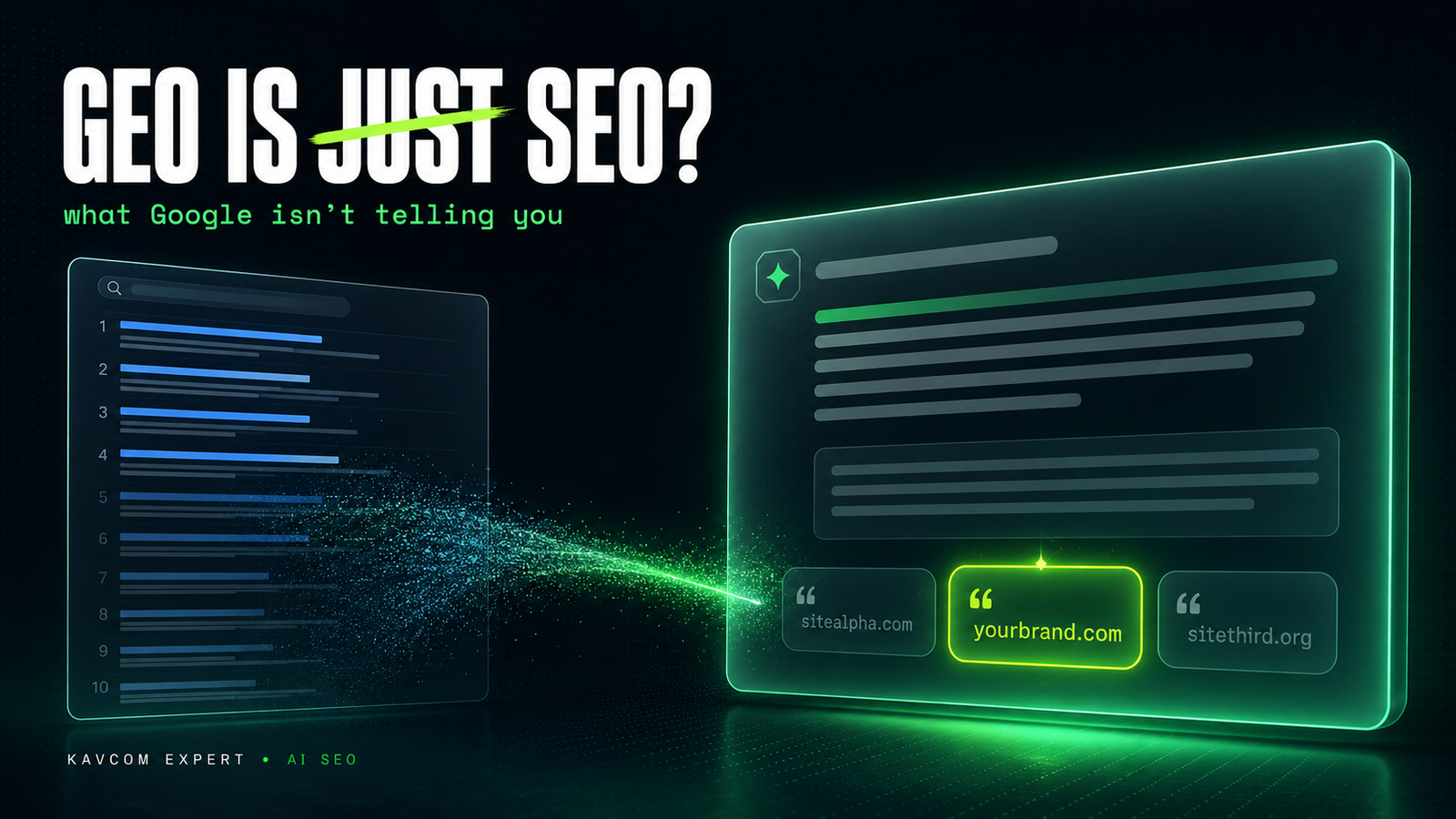
We already broke down why Google insists GEO is just SEO wearing a new coat, and the short version holds up here too: AI Overviews and AI Mode still run on top of the same crawling, indexing, and ranking systems that power regular search. A page with no technical foundation, no topical authority, and thin content was never going to get cited by an AI system either. GEO isn't a replacement for SEO fundamentals, it's an additional layer that decides, among the pages that already rank well, which ones actually get quoted.
This also lines up with the shift we wrote about in search everywhere optimization: your buyers aren't just typing into Google anymore, they're asking ChatGPT, scrolling TikTok, and checking Reddit threads before they land on a website. Zero-click search and AI Overviews are really one piece of that bigger pattern. The channels multiplied, and the "click" stopped being the only signal that matters.
A Practical GEO Checklist You Can Actually Run
None of this requires throwing out your content strategy. It requires adjusting how you write and structure what you publish.
1. Answer the question in the first two sentences. AI systems pull the most extractable chunk of a page, usually the part that most directly and plainly answers the query. Bury your answer under three paragraphs of preamble and you're making it easy to skip.
2. Back claims with real numbers and name your sources. This is the single tactic the Princeton research found made the biggest difference. Vague claims don't get quoted. Specific, sourced statistics do.
3. Structure for extraction, not just for humans skimming. Clear H2s and H3s, short paragraphs, numbered steps, and comparison tables all make it easier for a generative engine to pull a clean, self-contained chunk of your content.
4. Use structured data properly. FAQ schema, HowTo schema, and Article schema give AI crawlers explicit signals about what a section of your page is actually answering. It's one of the more overlooked parts of technical SEO right now, and one we go deeper on with clients through our SEO & AI SEO optimization service.
5. Build entity clarity. Make it obvious who wrote the content and why they're credible on the topic. Author bios, consistent branding across the web, and being mentioned on other authoritative sites all feed into whether an AI system treats your business as a trustworthy source.
6. Keep content fresh. Generative engines favor recently updated, accurate information. A statistics-heavy page from 2023 with no updates since is an easy one for an AI system to skip in favor of something current.
7. Track impressions and clicks separately in Search Console. This is the practical part most businesses skip. Filter for informational queries and watch for pages where impressions are flat or rising while clicks and CTR are falling. That pattern is the clearest sign an AI Overview is absorbing clicks that used to go to you.
What to Do If You're Already Seeing the Drop
If your rankings look fine but your organic traffic and leads have quietly slipped over the last several months, don't assume you did something wrong. It's very likely the search results page itself changed underneath you.
Start by pulling a quarter-over-quarter Search Console comparison, filtered to your top informational pages. If you see the impressions-up, clicks-down pattern described above, that content is a strong candidate for a GEO pass: tighten the direct answer at the top, add sourced statistics, and check whether FAQ or HowTo schema is missing. Pages tied to transactions, bookings, or local service areas are usually a lower priority here, since those queries are more click-resistant to begin with.
Frequently asked questions
What is zero-click search?
Zero-click search is when a Google user gets a complete answer directly on the search results page and never clicks through to a website. It happens through featured snippets, knowledge panels, and increasingly AI Overviews.
How much does an AI Overview reduce clicks?
Estimates vary by study, but most current research puts the click-through rate drop somewhere between 40% and 60% for a page that would otherwise rank in position one, once an AI Overview appears above it.
Is GEO the same thing as SEO?
They overlap heavily but aren't identical. SEO gets your page ranked. GEO increases the odds that an AI system quotes or cites your content once it's already in the pool of credible, well-ranked sources. You need both.
Which types of content are most at risk from AI Overviews?
Broad informational content, definitions, general how-to guides, and "best of" list posts are the most exposed, since that's the content AI Overviews summarize most easily. Local, transactional, and highly specific queries are more resistant.
How do I know if AI Overviews are costing me traffic?
Check Google Search Console for pages where impressions are stable or growing but clicks and click-through rate are dropping on the same queries, especially informational ones. That pattern is the clearest available signal right now.