 Kavcom Expert
Search Everywhere Optimization: Why Single-Channel SEO Is Dead

Quick answer
Search everywhere optimization means making your business visible across Google, AI assistants, YouTube, social platforms, and community forums instead of relying on Google rankings alone. Single-channel SEO is dead because buyers now split their search behavior across multiple platforms, and a business that only ranks on Google is invisible for a growing share of those searches. The fix is one connected strategy: create core content once, adapt it for every platform your audience uses, and build trust signals that AI engines and humans both cite.
Key takeaways
- Buyers no longer search in one place. They move between Google, ChatGPT, YouTube, TikTok, Reddit, and voice assistants depending on the question, so visibility on a single channel means missing everyone else.
- Search everywhere optimization is not five separate strategies. It is one core content strategy repurposed and adapted for each platform where your audience spends time.
- AI answer engines cite a small set of trusted sources. Reviews, creator content, community mentions, and consistent business information across platforms decide whether you get cited or ignored.
- Google still matters, but it is now one channel among many. Treat your website as the home base that every other platform points back to, not the only place you exist.
- Service businesses that adapt early win disproportionately, because most of their local competitors are still fighting over Google rankings alone.
Last month, a CPA firm owner told us something that stuck with us.
She had spent two years and a serious budget getting her firm to rank on the first page of Google for her main services. The rankings held. The traffic was fine. But new client inquiries had gone flat.
So we asked her a simple question. When you personally need a service you have never bought before, where do you look first?
She paused. Then she laughed. "Honestly? I asked ChatGPT to recommend a bookkeeper for my sister last week. And I found my hairdresser on Instagram."
That pause is the whole story. She was investing everything in one channel while personally searching on three others. Her prospects are doing the exact same thing. And that gap between where businesses optimize and where buyers actually search is why single-channel SEO is dead.
What Is Search Everywhere Optimization?
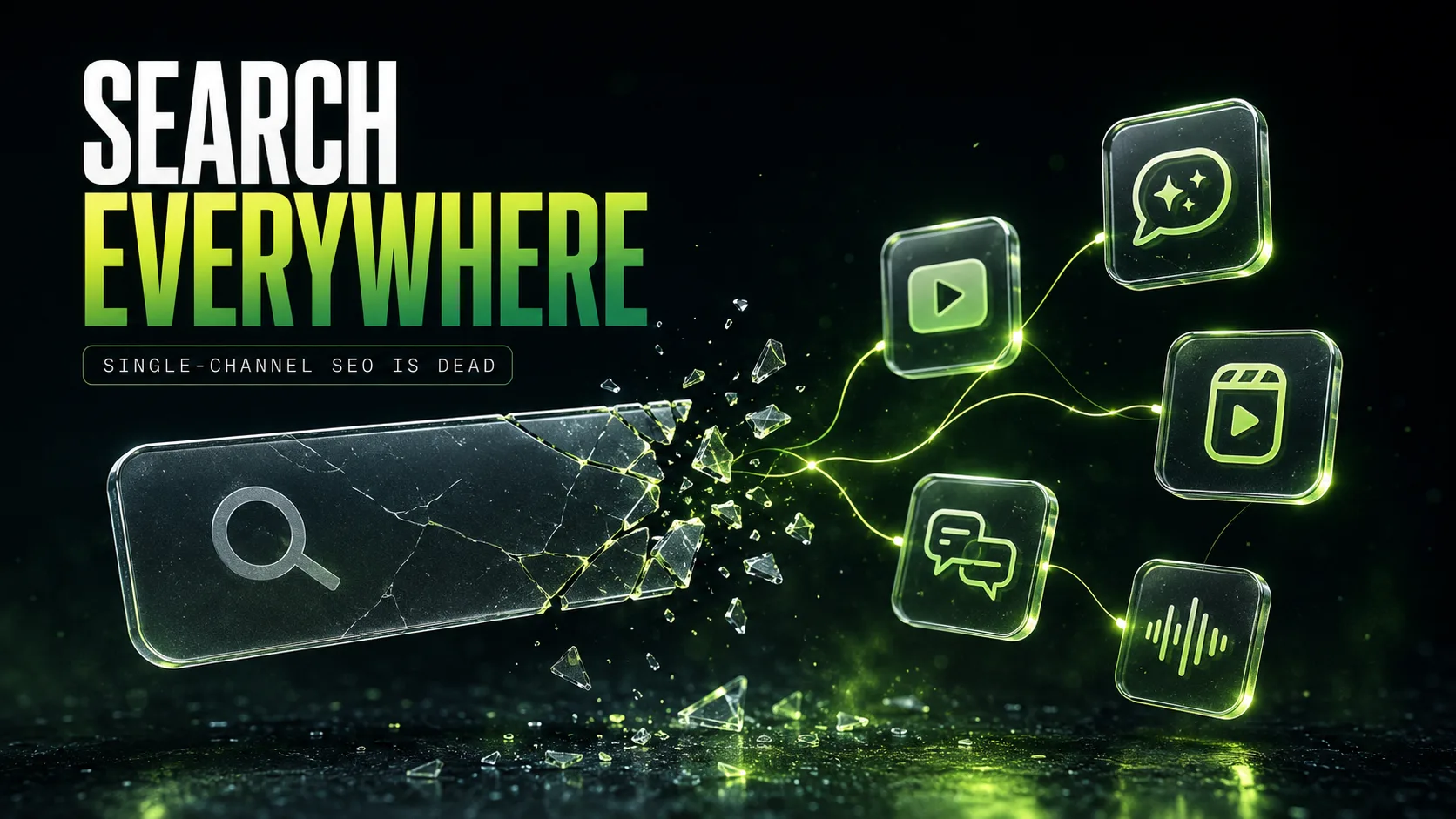
Search everywhere optimization is the practice of making your business findable on every platform where your audience searches, not just traditional search engines. That includes Google, but also AI assistants like ChatGPT and Gemini, video platforms like YouTube, social platforms like TikTok, Instagram, and LinkedIn, and community spaces like Reddit and Quora.
The idea is simple. Search behavior has fragmented. A single buyer might ask ChatGPT for a shortlist, watch two YouTube videos comparing options, check Reddit for unfiltered opinions, and only then type a brand name into Google. If you are only visible at that final step, you were never part of the decision. You were just the address they typed after someone else won the sale.
Search everywhere optimization closes that gap by treating all of these platforms as search engines, because functionally, that is what they have become.
Why Single-Channel SEO Stopped Working
Nobody sent a memo announcing that single-channel SEO was over. It faded quietly, and most businesses only noticed when the leads slowed down. Three shifts caused it.
First, the search itself moved. Younger buyers routinely open TikTok or Instagram to find restaurants, services, and products. Professionals ask AI assistants for vendor recommendations. Homebuyers watch YouTube neighborhood tours before contacting an agent. Every one of those moments is a search that Google never sees.
Second, Google started answering questions itself. With AI Overviews and AI Mode, Google increasingly gives users the answer directly on the results page. You can rank number one and still get fewer clicks than you did three years ago, because the answer box above you already satisfied the searcher. Ranking is no longer the same as being seen.
Third, trust moved to people and communities. Buyers trust a Reddit thread, a client review, or a creator walking through their real experience more than they trust a polished service page. AI engines have noticed, and they lean on those same signals when deciding who to recommend. If your business has no footprint in those spaces, you are invisible to both the humans and the machines.
Put those three shifts together and the math is brutal. Single-channel SEO now optimizes for a shrinking slice of a pie that used to be the whole bakery.
How Search Everywhere Optimization Works in Practice
Here is the part that surprises most business owners we talk to. Search everywhere optimization does not mean doing five times the work. It means doing the work once and distributing it intelligently.
Think of it as one engine with many outlets.
Start with one strong core asset. A detailed blog post, a case study, or a recorded client Q&A. Something with real substance that answers a question your buyers actually ask.
Then adapt it for each platform. That blog post becomes a YouTube video script. The video becomes three short clips for Instagram and TikTok. The key insight becomes a LinkedIn post. The common objections become a Reddit-friendly answer or an FAQ on your site. Same knowledge, five formats, five search surfaces.
Make your business machine-readable. AI engines recommend businesses they can clearly understand and verify. That means consistent name, services, and location across your website, Google Business Profile, and social profiles, plus FAQ content, structured data, and clear direct answers on your pages. This is where AEO, answer engine optimization, lives inside a search everywhere optimization strategy.
Build proof everywhere. Reviews on Google and industry platforms. Client results published as case studies. Mentions in community threads. Creator or partner content that references you. These are the trust signals that both people and AI systems cite when they decide who deserves the recommendation.
Keep your website as home base. Every platform trend rises and falls, but your website is the one asset you own. Everything else should point back to it, and it should be fast, clear, and ready to convert the attention the other channels send.
What This Looks Like for a Service Business
Let us make it concrete with the real estate example, because we see this play out with agents constantly.
An agent running single-channel SEO writes blog posts about "homes for sale in Tampa Bay" and hopes to outrank Zillow. That is a losing fight.
An agent running search everywhere optimization records one honest video per week answering a real buyer question. That video lives on YouTube, gets clipped for Instagram, gets summarized as a blog post with an FAQ section on her site, and gets referenced when she answers questions in local Facebook groups. Six months later, when someone asks an AI assistant about working with an agent in her area, guess whose name has the review count, the video library, and the community footprint to get cited.
The same logic applies to CPA firms, contractors, consultants, and every other service business. The winners are not producing more content. They are producing connected content.
Is Google SEO Dead Then?
No, and anyone telling you to abandon Google is selling something.
Google is still the largest single search platform, and traditional SEO fundamentals like site speed, clean structure, quality content, and local optimization still matter. The point is not that Google stopped working. The point is that Google alone stopped being enough.
Single-channel SEO is dead. Google as one strong channel inside a search everywhere optimization strategy is very much alive.
How to Start Without Overwhelming Your Team
You do not need to be everywhere on day one. You need to be where your buyers are, in order of impact.
Audit your visibility honestly. Ask ChatGPT and Gemini about businesses like yours. Search your service on TikTok and YouTube. See who shows up. It probably is not you, and now you know the gap.
Pick your two highest-impact platforms beyond Google. For most service businesses, that is YouTube plus one social platform where your clients actually spend time.
Build a repurposing workflow. One core piece of content per week, adapted into platform-native formats. Consistency beats volume every single time.
Fix your answer-readiness. Add FAQ sections, direct answers, and structured data to your key pages so AI engines can quote you cleanly.
Collect proof relentlessly. Reviews, testimonials, and case studies are no longer nice to have. They are ranking factors for the entire search everywhere ecosystem.
The businesses winning right now are not the ones with the biggest budgets. They are the ones who accepted early that search changed, and rebuilt their strategy around where buyers actually look.
That CPA firm owner we mentioned at the start? She now publishes one video a week, her firm shows up when AI assistants get asked about accountants in her city, and her inquiries are growing again. Nothing about her expertise changed. Only her visibility did.
Ready to Be Found Everywhere?
At Kavcom Expert, we build search everywhere optimization strategies for CPA firms, real estate professionals, and service businesses that are done relying on a single channel. From SEO and AEO to video content and social search, we handle the entire visibility engine so you can focus on serving clients.
Book a free visibility audit and we will show you exactly where your buyers are searching and where you are missing.
Frequently asked questions
What is search everywhere optimization?
Search everywhere optimization is a marketing strategy that makes your business visible across all platforms where people search, including Google, AI assistants like ChatGPT, YouTube, TikTok, Instagram, and community forums like Reddit. Instead of optimizing for one search engine, you optimize for every place your buyers look for answers and recommendations.
Why is single-channel SEO no longer enough?
Single-channel SEO is no longer enough because search behavior has fragmented. Buyers now split their searches across AI assistants, social platforms, video platforms, and communities, and Google itself answers many queries directly on the results page. A business that only ranks on Google misses every search that happens somewhere else.
Is traditional SEO dead in 2026?
No. Traditional SEO fundamentals like quality content, site speed, and local optimization still matter, and Google remains the largest single search platform. What is dead is relying on Google alone. Traditional SEO now works best as one channel inside a broader search everywhere optimization strategy.
How is search everywhere optimization different from AEO and GEO?
AEO (answer engine optimization) focuses on appearing as direct answers in search and voice results, while GEO (generative engine optimization) focuses on being cited by AI tools like ChatGPT and Gemini. Search everywhere optimization is the umbrella strategy that includes both, plus visibility on social platforms, video, and communities.
How much content do I need for search everywhere optimization?
Less than you think. Most service businesses can run an effective search everywhere optimization strategy with one strong core piece of content per week, repurposed into platform-native formats like video clips, social posts, and FAQ answers. Consistency and adaptation matter more than raw volume.
Which platforms should a small business prioritize first?
Start with Google plus the two platforms where your specific audience already searches. For most service businesses, that is YouTube and one social platform such as LinkedIn for B2B or Instagram for local consumer services. Add AI answer readiness to your website from day one, since it requires updating existing pages rather than creating new content.