
For most small businesses, ChatGPT ads are worth a small, carefully measured test, but not a big share of your budget yet. OpenAI opened its self-serve Ads Manager to US businesses in May 2026 and removed the minimum spend that kept smaller advertisers out. Since then it has added the controls you'd expect, such as daily budgets, location targeting and conversion tracking. If you sell to other businesses or offer a service people research before buying, a test makes sense. If you're a local or regulated business with Google Ads campaigns that already work, there's less reason to rush.
Here's what's available, who it suits, and how to run a first test without wasting money.
What changed in 2026
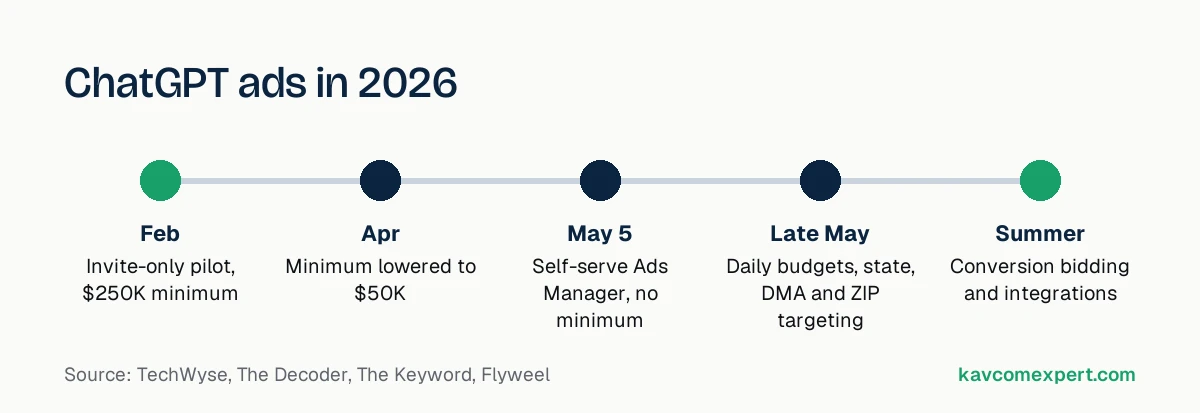
ChatGPT ads started as an invite-only pilot for large brands. According to TechWyse, the minimum commitment was $250,000 during the February pilot and $50,000 by April.
That changed on May 5, 2026. The Decoder reported that OpenAI launched a self-serve Ads Manager in beta for US businesses, dropped the $50,000 minimum, added cost-per-click buying alongside cost-per-impression, and introduced a pixel and Conversions API for measurement. It also reported that OpenAI is aiming for about $2.5 billion in ad revenue in 2026, which tells you this isn't a side project.
A few weeks later, The Keyword reported more controls. Advertisers can now set daily or lifetime budgets. US location targeting covers states, designated market areas (DMAs) and ZIP codes, and reporting shows impression, click and spend totals at campaign, ad group and ad level.
Third-party trackers such as Flyweel's running summary (last updated October 14, 2026) list further additions since then, including conversion-based bidding in June, customer list audiences by July, and HubSpot and Shopify integrations in September. OpenAI ships changes often, so check the Ads Manager itself for the current feature set before planning around any one of them.
Who actually sees the ads
This matters more than anything else when you decide whether to test. According to The Keyword, ChatGPT ads are shown only to people on the Free and Go plans. Plus, Pro, Business, Enterprise and Edu subscribers don't see ads at all.
Ads appear when a conversation relates to shopping, product discovery or making a decision. So the opportunity is people researching a purchase or comparing options inside ChatGPT, on the free or lower-cost plans. That's a large audience, but it's not everyone, and it leaves out many of the professionals who pay for ChatGPT through work.
How ChatGPT ads differ from Google Ads
The biggest difference is intent. On Google, someone types "emergency plumber Tampa" and you bid on that phrase. In ChatGPT, people describe a problem in a full conversation, and the ad shows up when the conversation is relevant. You're closer to a recommendation than a search result.
| Feature | Google Search ads | ChatGPT ads |
|---|---|---|
| How people find you | They type a search | The conversation turns to a purchase or decision |
| Targeting | Keywords, audiences, locations, devices | Conversation context, US states, DMAs and ZIP codes |
| Who you reach | Almost everyone who searches on Google | ChatGPT Free and Go users only |
| Buying options | CPC, conversion bidding, many strategies | CPC and CPM, with conversion bidding added later |
| Maturity | Over 20 years of tools and data | A new platform, still in beta and changing often |
| Best use for a small business | Your main source of paid leads | A capped test alongside what already works |
Who should test it now
Based on the early guidance from agencies like WebFX, and what we've seen so far, these businesses have the best reasons to try it:
- B2B companies and software businesses whose buyers research for weeks and compare options
- Professional services with a longer decision, such as accounting, consulting, agencies and specialist contractors
- Online stores with a clear product people ask ChatGPT to compare, especially if you can tie sales back with the pixel
- Businesses with a strong, specific offer and a landing page built around it
What these have in common is that people tend to ask ChatGPT about them before buying. If you can imagine a customer typing "what should I look for in a bookkeeping service for a small restaurant?", you're a good candidate.
Who should probably wait
- Local service businesses that already get steady leads from Google Ads and Local Services Ads. Location targeting exists now, but the volume of local "near me" style decisions inside ChatGPT is still unproven.
- Regulated categories such as health, legal, financial products and anything with strict ad rules. Ads go through review, and policies on a young platform can change quickly.
- Businesses with no conversion tracking. If you can't tell whether a lead came from Google or ChatGPT, you won't learn anything from the test.
- Anyone whose total ad budget is very tight. Fix the basics on proven channels first.
How to run a first test
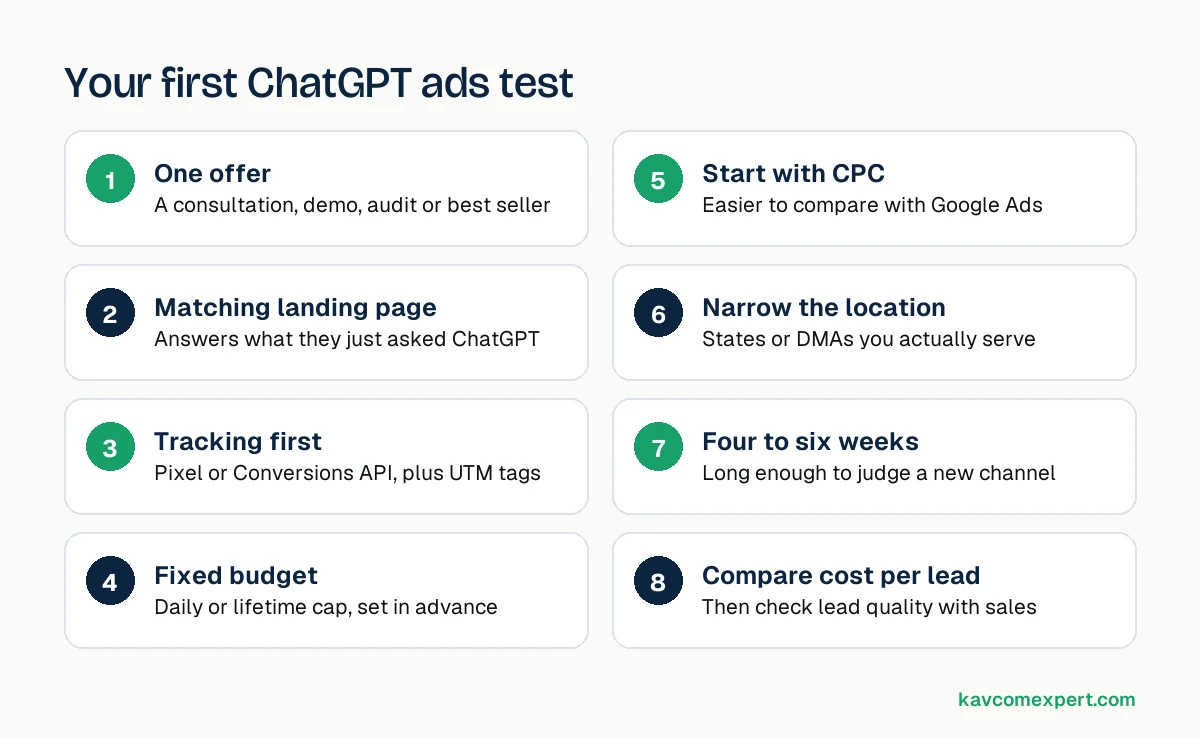
A good test is small, has a fixed end date, and answers one question: can this channel bring customers at a cost per lead or sale you'd be happy with?
- Pick one offer. A consultation, a demo, a free audit or a single best-selling product. Don't send ads to your homepage.
- Build or choose a landing page that matches it. It should answer the questions someone would have just asked ChatGPT.
- Install tracking first. Add the OpenAI pixel or Conversions API, put UTM tags on your ad links, and make sure leads show up in your CRM with their source.
- Set a fixed budget. Use a daily or lifetime cap and decide in advance the total you're willing to spend on the test.
- Start with clicks. CPC buying makes it easier to compare with your Google Ads costs than CPM.
- Narrow the location if it matters. If you only serve certain states or metro areas, use the DMA or state targeting.
- Run it for four to six weeks. A week or two isn't enough to judge a new channel.
- Compare cost per lead or sale, not clicks. Then check lead quality with whoever handles sales.
How to read the results
After four to six weeks you'll have enough data to make a decision. Most tests land in one of three places.
It brought leads at a cost you'd accept
Keep it running, raise the budget slowly (for example by 20% every couple of weeks), and add a second offer. Keep checking lead quality, because cheap leads that never buy aren't cheap.
It brought clicks but few leads
This usually points at the landing page or the offer, not the channel. Look at what people did after the click. If they left within a few seconds, the page didn't match what they expected. Try a page that answers the question more directly, or a lower-commitment offer like a checklist or a price guide.
It brought almost nothing
Stop the test and note what you learned. Your category may not come up often in ChatGPT conversations yet, or the people who ask about it may be on paid plans that don't show ads. Put a reminder in your calendar to look again in six months, since the platform is changing quickly.
Whatever the result, write down the spend, the leads, the cost per lead and what you changed. That record is worth more than the test itself the next time someone asks whether you should "do AI ads."
Writing ads for a conversation
People reading a ChatGPT answer are in research mode. An ad that sounds like a banner ("BEST PRICES! CALL NOW!") will feel out of place. Ads that do better tend to:
- Say plainly what you offer and who it's for
- Mention one specific benefit or proof point, like years in business, a guarantee or a price range
- Offer a useful next step, such as a checklist, a quote or a short call
- Match the landing page word for word, so the click feels like a continuation
Getting recommended without paying
Ads are one way to appear in ChatGPT. The other is being the business that ChatGPT and other AI tools already mention when people ask about your category. That comes from clear, well-sourced content on your site, consistent business details across the web, and real reviews.
If you haven't worked on that yet, start with our guides to getting your business found by AI search and zero-click search and AI Overviews. For many small businesses, organic AI visibility pays off longer than a paid test.
Where to get help
If you'd like a second pair of eyes before spending money, our Google Ads and paid search team can plan a ChatGPT test alongside your existing campaigns, and our SEO and AI search team works on the organic side. You can also contact us with your current ad spend and goals, and we'll tell you honestly whether a test makes sense for you right now.
Sources
- The Decoder: ChatGPT ads are now open to small businesses (May 6, 2026)
- TechWyse: OpenAI ChatGPT Ads Manager adds CPC bidding
- The Keyword: OpenAI updates ChatGPT Ads Manager with daily budgets (May 25, 2026)
- WebFX: ChatGPT Ads Manager
- Flyweel: OpenAI ChatGPT Ads Manager costs, billing and what changed in 2026 (updated October 14, 2026)